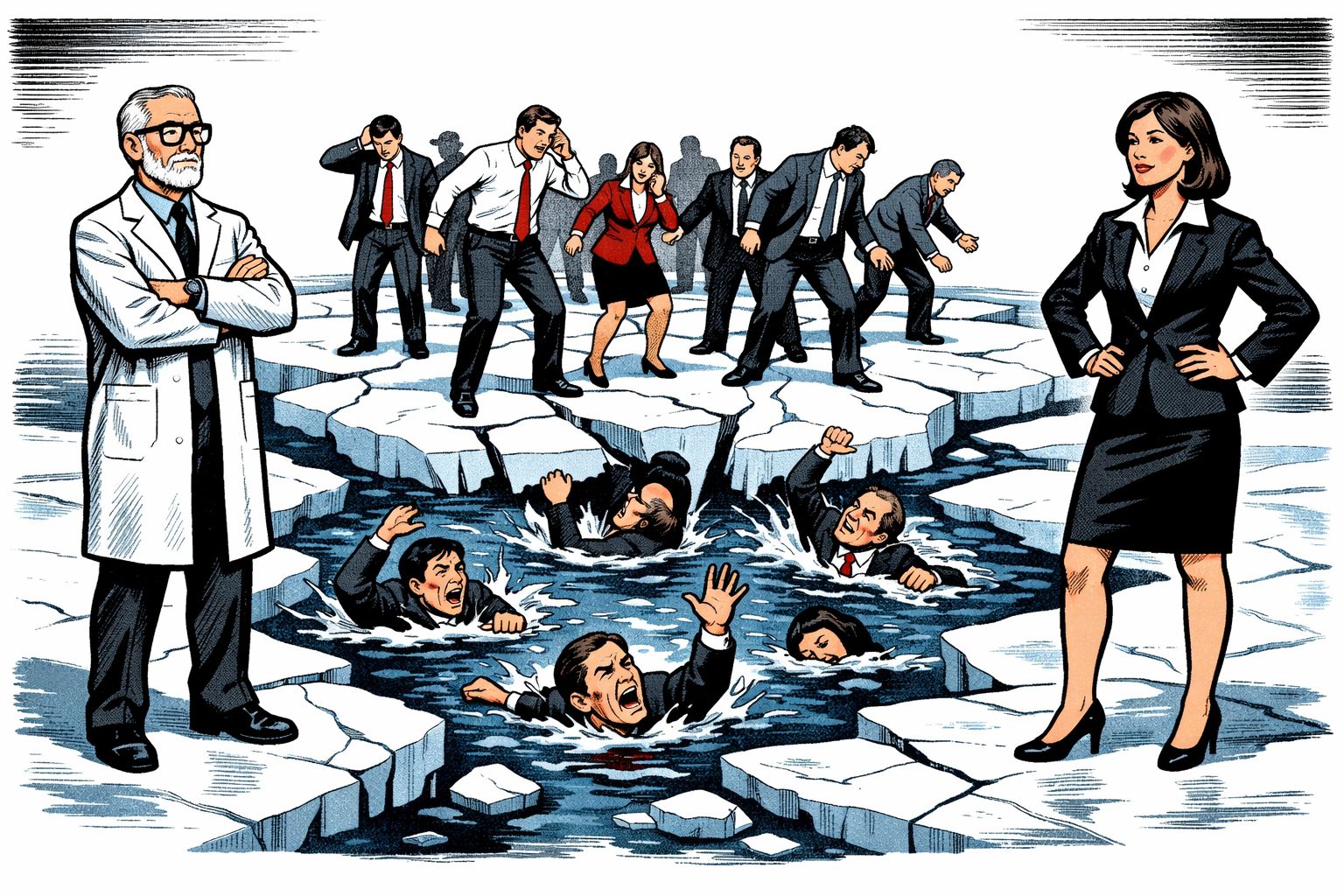
There’s a book from the pre-AI era called “Be Obsessed or Be Average.” Back then, it sounded like a motivational catchphrase. Today, it sounds more like a warning. Artificial intelligence is rapidly erasing the line between “average” and “unnecessary” — for both people and software.
Average Is No Longer Enough
Chatbots handle customer support. Automated systems take over administration. According to a McKinsey report, many corporate departments will need fewer employees as a direct result of AI deployment — while revenue per employee keeps rising. Some forecasters even predict the end of the “laptop class”: if your job doesn’t require physical presence, AI can replace you — working around the clock for a fraction of your salary.
And it’s not just about people. Think of all those video-to-MP3 converters, simple image editors, and similar utilities you once paid tens of dollars for. Today, you tell an AI what you need and get a custom-built app. Their era is ending. And it’s not just small tools — companies are seriously considering how to replace software they pay hundreds of thousands for annually. A small business can use AI to build its own CRM for a fraction of the cost of a commercial solution.
More broadly, every product or service whose output isn’t a physical object is at risk. Publications, consulting, analytics, software tools — anything that can be expressed in words, numbers, or code is entering direct competition with AI.
Will AI Replace You?
Think about it — there’s a fairly simple test: can your work be documented? If so, it can be automated.
This isn’t abstract theory. If your company has workers whose job consists of applying knowledge prepared by someone else — people working with internal procedures, manuals, knowledge bases — AI can replace them. Under one condition: that knowledge must be written down. AI can then not only make that knowledge accessible but actively apply it — faster and more consistently than a person who has to study it first.
The same applies to software. If your application’s entire logic can be described by a set of rules that AI can understand, then your application no longer has a reason to exist. The user will simply have it generated.
The boundary of replaceability doesn’t run between humans and machines, nor between software and AI. It runs between what can be written down and what cannot. Between routine and creativity. Between average and exceptional.
A New Definition of Exceptional
And here’s where it gets most interesting. Look at the highest-paid professions today. At the top, you’ll find two types of people: specialists who create new knowledge — commercial researchers, experts at the cutting edge of their field — and high-level managers who can extract maximum value from existing knowledge and resources. These two groups form the peaks of the value curve. Between them lies a broad middle layer of people who apply existing knowledge.
AI is erasing that middle layer. And in doing so, it makes those two peaks the only path to staying irreplaceable.
Either you’re a specialist who creates new knowledge — pushing the boundaries of what we know and can do. Your output will eventually become documented knowledge that AI absorbs and applies. But the act of creation itself — seeing a problem no one else sees, coming up with an approach that didn’t exist before — that cannot be automated. You feed the machine what it learns from.
Or you’re a manager who extracts value from AI — you know what to ask, how to combine outputs, when to trust AI and when not to. You don’t create new knowledge, but you orchestrate existing knowledge. Your value lies in judgment, context, and the ability to bear responsibility for the outcome.
Notice: this is nothing new. The world has always worked this way. It’s just that the middle layer — people who apply others’ knowledge without creating their own or making critical decisions — used to be numerous and well-paid. AI is compressing it, because this is precisely the kind of work that can be documented. And what can be documented can be automated.
The same goes for software. The tools that survive will either create new value in ways AI cannot replicate, or serve as platforms for AI orchestration. Everything in between is at risk.
What to Do About It
If you’re reading this article thinking you belong to that middle layer — I have good news: realizing it is the first step. The question you need to ask yourself is simple: am I creating new knowledge, or applying existing knowledge?
If you’re applying — move. Either toward creation: deepen your expertise where AI still struggles — in strategic thinking, in understanding context, in solving problems no one has solved before. Or toward orchestration: learn to effectively manage AI in your field, not as a toy, but as a tool that multiplies your productivity and decision-making ability.
The same applies to software companies. If your product is easily replicable, you have a problem. But if you can integrate AI into your solution and offer customers something they can’t generate on their own, you have an opportunity, not a threat.
Be Obsessed or Be Obsolete
The era when you could make a good living by applying others’ knowledge is ending. The future belongs to those who create knowledge, or to those who can orchestrate it. The middle is hollowing out.
Be Obsessed or be Obsolete.